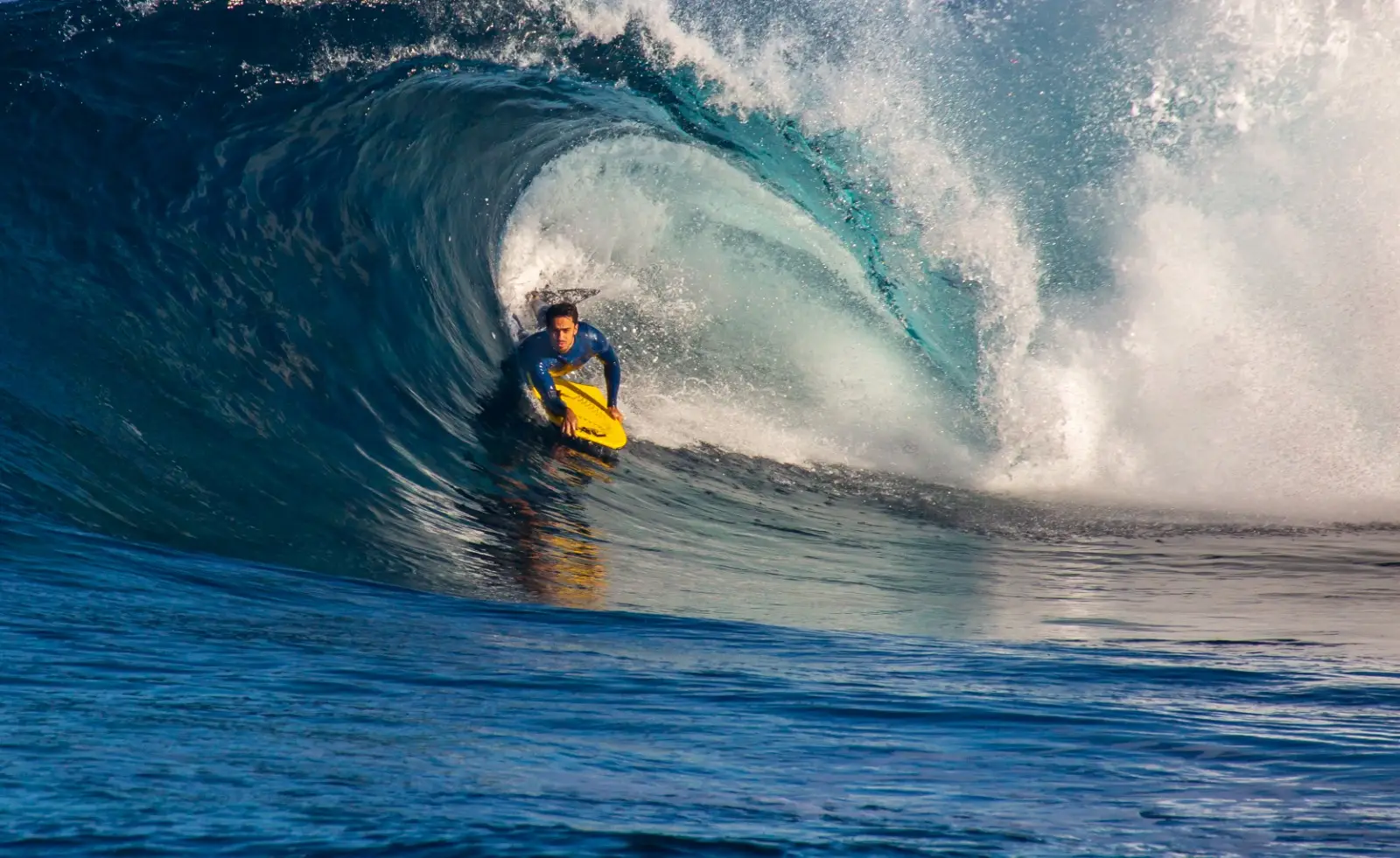
Kitchen Windows is an A-frame wave off Dolphin Main Beach in Jeffreys Bay, a short drive down the bay from Supertubes. It's where many of the town's surf schools run their lessons: on the low tide it offers soft whitewater walls for learning to stand up. On the high tide it gets heavy, with powerful close-outs that make for some fun, punchy rides. A good wave for beginners and intermediates, and a mellower option when the point is too big or too crowded.
🌡️ ~18.8°C now · a 3/2mm full suit, or a shorty if you run warm
This week at Kitchen Windows (Jeffreys Bay): 4–6 ft, clean mornings most days. Best day: Thu (intermediate).
About normal for November (avg 4.9 ft).
Thu
6–7 ft
8s E
AM wind: Offshore 9 km/h
IntermediateFri
5 ft
9s SE
AM wind: Offshore 16 km/h
BeginnerSat
4–5 ft
8s SE
AM wind: Offshore 22 km/h
BeginnerSun
4–6 ft
9s SW
AM wind: Offshore 14 km/h
IntermediateMon
4–6 ft
8s S
AM wind: Glassy 7 km/h
BeginnerTue
4 ft
8s SW
AM wind: Offshore 16 km/h
BeginnerWed
4 ft
9s SW
AM wind: Offshore 14 km/h
BeginnerUpdated Nov 19, 10:47 PM UTC · modelled swell and wind, not a surf report · Forecast data: Open-Meteo.com
Beginner: Jan, Feb, Mar, Apr, May, Nov, Dec
Intermediate: Apr, May, Jun, Jul, Aug, Sep, Oct
Advanced: not suitable for this level
Follow @surfscanners
New spots, best-month tips and the local crews at Kitchen Windows (Jeffreys Bay). Tag us in your clips and we'll share them.
Beginner: Jan, Feb, Mar, Apr, May, Nov, Dec
Intermediate: Apr, May, Jun, Jul, Aug, Sep, Oct
Advanced: not suitable for this level
All-time average wind & swell
Dashed line marks Kitchen Windows (Jeffreys Bay)'s known offshore direction. Bright arrow is the all-time average swell direction, colored arrow is the all-time average wind direction at 15 km/h — hover or tap either arrow for exact values.
Monthly avg wave height (ft)
Monthly avg wind speed (km/h)
| Jan | Feb | Mar | Apr | May | Jun | Jul | Aug | Sep | Oct | Nov | Dec |
| 20° | 20° | 20° | 18° | 18° | 16° | 16° | 17° | 18° | 18° | 19° | 20° |
Averages from 3 years of daily wave, wind and water temperature data — what a typical year looks like, not a forecast.
Waves average 4.7 ft (1.4 m), with cross-onshore winds around 15 km/h from the S. Water is ~20°C: a 3/2mm full suit, or a shorty if you run warm. A best month for beginners.
Waves average 4.8 ft (1.5 m), with cross-offshore winds around 14 km/h from the S. Water is ~20°C: a 3/2mm full suit, or a shorty if you run warm. A best month for beginners.
Waves average 5.2 ft (1.6 m), with cross-offshore winds around 13 km/h from the S. Water is ~20°C: a 3/2mm full suit, or a shorty if you run warm. A best month for beginners.
Waves average 5.3 ft (1.6 m), with offshore winds around 13 km/h from the W. Water is ~18°C: a 3/2mm full suit, or a shorty if you run warm. A best month for beginners and intermediates.
Waves average 5.4 ft (1.6 m), with offshore winds around 13 km/h from the NW. Water is ~18°C: a 3/2mm full suit, or a shorty if you run warm. A best month for beginners and intermediates.
Waves average 6.0 ft (1.8 m), with offshore winds around 16 km/h from the NW. Water is ~16°C: a 3/2mm full suit. A best month for intermediates.
Waves average 5.9 ft (1.8 m), with offshore winds around 16 km/h from the NW. Water is ~16°C: a 3/2mm full suit. A best month for intermediates.
Waves average 5.9 ft (1.8 m), with offshore winds around 15 km/h from the NW. Water is ~17°C: a 3/2mm full suit. A best month for intermediates.
Waves average 6.0 ft (1.8 m), with offshore winds around 15 km/h from the W. Water is ~18°C: a 3/2mm full suit, or a shorty if you run warm. A best month for intermediates.
Waves average 5.6 ft (1.7 m), with cross-offshore winds around 16 km/h from the S. Water is ~18°C: a 3/2mm full suit, or a shorty if you run warm. A best month for intermediates.
Waves average 4.9 ft (1.5 m), with cross-offshore winds around 14 km/h from the S. Water is ~19°C: a 3/2mm full suit, or a shorty if you run warm. A best month for beginners.
Waves average 4.9 ft (1.5 m), with cross-onshore winds around 15 km/h from the S. Water is ~20°C: a 3/2mm full suit, or a shorty if you run warm. A best month for beginners.
For beginners: Nov–May. For intermediates: Apr–Oct. The biggest waves come in June, averaging 6.0 ft (1.8 m), and the smallest in January, at 4.7 ft (1.4 m).
It ranges from ~16°C in July to ~20°C in January, averaged over 3 years of daily readings.
In July (~16°C): a 3/2mm full suit. In January (~20°C): a 3/2mm full suit, or a shorty if you run warm.
Yes. The best months for beginners are Nov–May, when waves average around 5.0 ft (1.5 m).
The nearest airport is PLZ, and the nearest town is Jeffreys Bay, South Africa.